
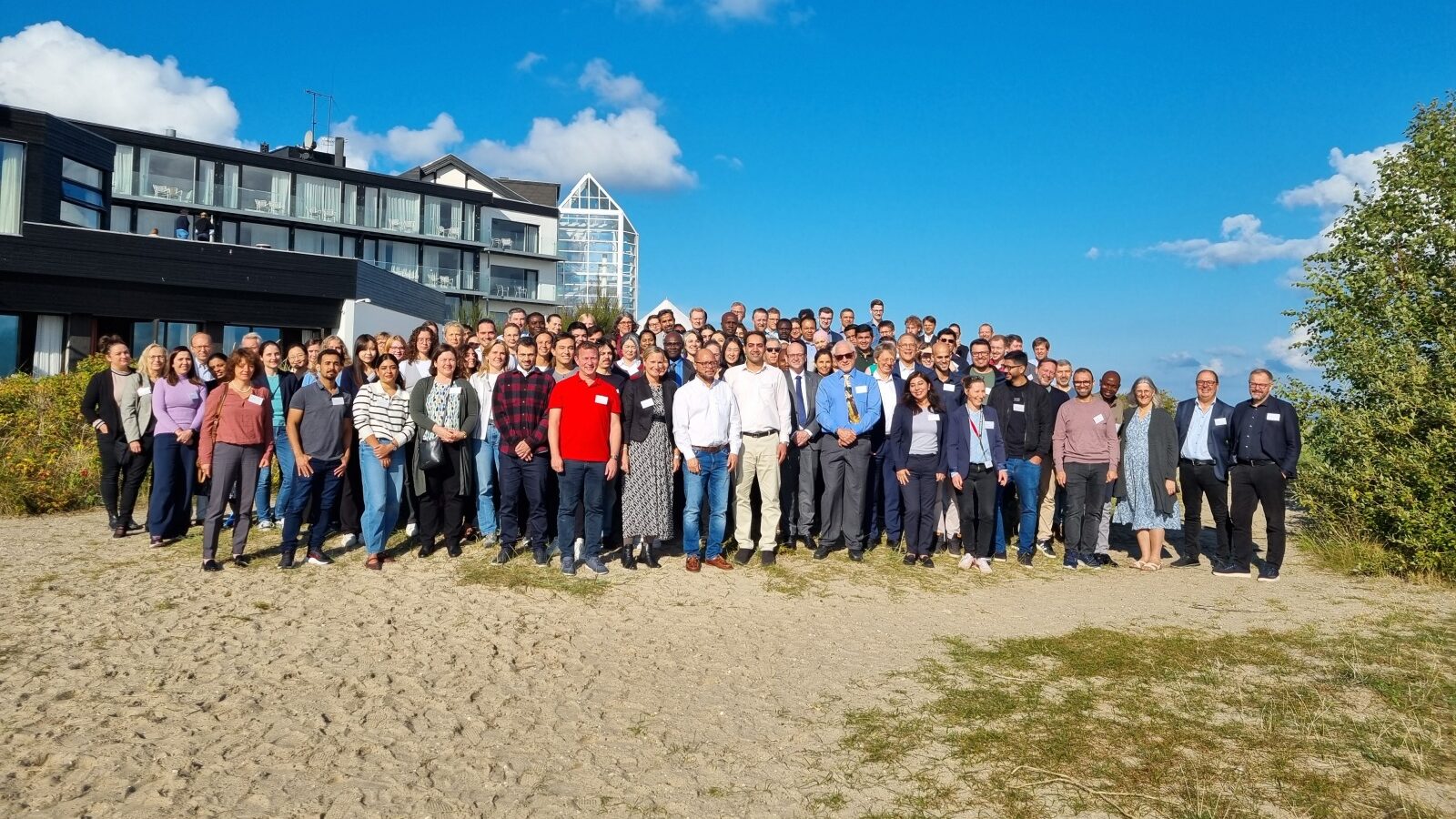
From September 29 to October 3, 2025, the Technical University of Denmark (DTU) hosted the “Key Technologies in Bioeconomy” conference, an annual event initiated and organised by the Global Bioeconomy Alliance.
This year, the annual Global Bioeconomy Alliance (GBA) brought together more than 200 representatives from research institutions, industry, and government agencies across Europe, Australia, Latin America, and beyond (Photo: Alcides Lopes Leão, UNESP. Group photo at Marienlyst Strandhotel, Denmark).
The conference week kicked off with a pre-conference at DTU, bringing together industry representatives, political stakeholders and researchers. The day began with a keynote speech by Luuk van der Wielen, the newly appointed Director of BRIGHT at DTU, who provided an introduction to the field and shared BRIGHT’s vision for strengthening Denmark’s position in the bio-based economy. The program featured three sessions exploring key questions: How can the world’s leading bioeconomy nations collaborate across borders? How do we build a common European approach and scale solutions globally? And finally, the industry perspective – what challenges does the sector face when scaling biosolutions? A recurring message throughout the day was clear: biosolutions must play a central role in the future economy, and Europe needs to accelerate efforts to bring these solutions to market. Achieving this will require adapting and rethinking current models. On this front, Denmark and Europe can learn valuable lessons from countries like Brazil, Mexico and Australia.
Among the speakers were high-level guests such as Denmark’s Minister for the Green Tripartite Agreement, Jeppe Bruus; ambassadors from Mexico, Mrs. Norma Pensado; Brazil, Mr. Leonardo Gorgulho; Germany, Mrs. Anke Meyer; and Australia, Mr. Dave Vosen; industry representatives; as well as representatives from the European Commission, including Adrian Leip, Head of Sector – Bioeconomy.
To me this is one of the most important series of conferences I attend because of the ambitious goal of connecting many different aspects of sustainable bioeconomy, while still maintaining a high scientific level.
Participant at the GBA-conference

The second day of the conference week was spent on a visit to Kalundborg Symbiosis, where participants had the opportunity to hear a series of presentations from Kalundborg Symbiosis, Knowledge Hub Zealand, Helix Lab, Novonesis, Kalundborg Utility, and FermHub. Participants gained valuable insights into how circular thinking can deliver significant economic benefits and how the entire community of Kalundborg has evolved into an integrated industrial ecosystem. The participants also had the opportunity to see real-life infrastructure, including steel tanks, pipes, and processing equipment.

I was impressed by the Kalundborg site and the foresight of the synergistic infrastructure
Participant in the Kalundborg visit
The last three days of the conference featured discussions on high-impact areas such as sustainable agriculture, biomaterials and biobased conversion, cell-free biomanufacturing, and sustainable mining. The program featured action-oriented sessions and workshops designed to strengthen collaboration and accelerate technology adoption.
Scientists, policymakers, and industry leaders explored the broader governance and innovation frameworks needed for a fair and coordinated global bioeconomy transition. A key highlight was an interactive, moderated innovation workshop that engaged all participants in shaping the future direction of the Global Bioeconomy Alliance. The conference also celebrated leadership and impact, reinforcing confidence in the trajectory of emerging biosolutions. Altogether, the event underscored the Alliance’s role as a unifying force driving collaborative action toward a regenerative and equitable green economy

The GBA has connected me with new and thriving collaborations that directly enrich my research in ways that would not have been possible otherwise
Participant at the GBA-conference
This year’s GBA Conference was also the year when the GBA Award for Impact and Leadership in Bioeconomy was presented for the first time. The winner was Prof. Yan Zhou, who is the Associate Chair (Faculty) at Nanyang Technological University’s School of Civil and Environmental Engineering (CEE), Singapore, for her research in sustainable sludge treatment, which transforms waste into renewable resources through green processes. The award will be presented for the next two years and consists of €100,000 for research and €15,000 as a personal prize.

The conference was supported by the Novo Nordisk Foundation, which also includes support for more than 20 young researchers from around the world to participate at the conference.
Many of these young researchers participated in the group of more than 50 researchers who contributed to the poster session. Two researchers were selected as winners of gift cards to support their participation at next year’s GBA conference.
During the conference, an article featuring Gerhard Schenk, Professor at the University of Queensland, Volker Sieber, Rector at TUM Straubing, and Dulce H. S. Silva, Professor at UNESP, was published in Nature Sustainability, in which they share more about the work and vision of the Global Bioeconomy Alliance (https://doi.org/10.1038/s41893-025-01660-3).